



If the idea of gliding across Spain at 300 km/h grabs your attention, choosing between Avlo vs. OUIGO is the next big decision. Both trains give you the thrill of high-speed travel without the high-speed price, but they take different approaches to comfort and convenience.
Avlo sticks to a straightforward setup with simple fares and minimal extras, perfect for travellers who prefer clarity over customisation. OUIGO adds optional upgrades and a livelier atmosphere, giving you a bit more control over your experience. Understanding how these two low-cost trains in Spain differ makes it much easier to choose the ride that truly fits your needs.
What are the main differences between Avlo and OUIGO trains?
The real contrast between Avlo and OUIGO trains is in baggage policies, onboard services, available routes, and optional upgrades. Avlo is the more stripped-down option, offering simple fares and a clear luggage allowance that works well for light travellers.
OUIGO adds more personality, from paid extras to roomier seating choices if you want them. Their routes overlap in major corridors, but each covers a few destinations that the other skips. These minor differences can shape your whole trip, so it's worth comparing before you book.
Origin and operators: Avlo vs. OUIGO
Their different origins explain why each service feels unique, even if both aim to keep fares low.
What routes and destinations do Avlo and OUIGO offer in Spain?
When it comes to getting around with low-cost trains in Spain, the biggest difference between Avlo and OUIGO is how far their networks reach. Avlo, backed by Renfe, has the advantage of a much wider and more established route map.
It connects major hubs like Madrid, Barcelona, Zaragoza, Valencia, Alicante, Seville, Málaga, and Córdoba, plus a long list of secondary cities across northern Spain and the Mediterranean corridor. This means you can travel directly to your final stop without hunting for an extra transfer. For anyone heading to a smaller city or somewhere slightly off the usual tourist path, Avlo usually offers the smoother, more convenient option.
OUIGO, on the other hand, runs on a more limited, but steadily expanding, network. It focuses mainly on key high-traffic corridors, linking cities such as Madrid, Barcelona, Zaragoza, Valencia, Tarragona, Alicante, Albacete, Cuenca, Valladolid, Segovia, Murcia, Elche, Córdoba, Seville, and Málaga. The coverage is solid if you're travelling between major hubs or sticking to well-known routes between the centre, the east coast, and Andalusia. While OUIGO's network doesn't stretch quite as far as Avlo's, it continues to grow year by year, adding more destinations and strengthening its presence.
Avlo wins on sheer coverage and convenience, especially if you're exploring beyond Spain's biggest cities, while OUIGO keeps things focused but continues to push outward, making it easier over time to choose a budget-friendly ride.
Pricing: Which train ticket is cheaper, Avlo or OUIGO?
Because both use dynamic pricing, the exact cost depends on when you book and how busy the trains are. Still, on Avlo or OUIGO, which is cheaper, Avlo is usually the safer bet, but OUIGO's promotions can make it a real contender.

Included baggage: What are the baggage differences?
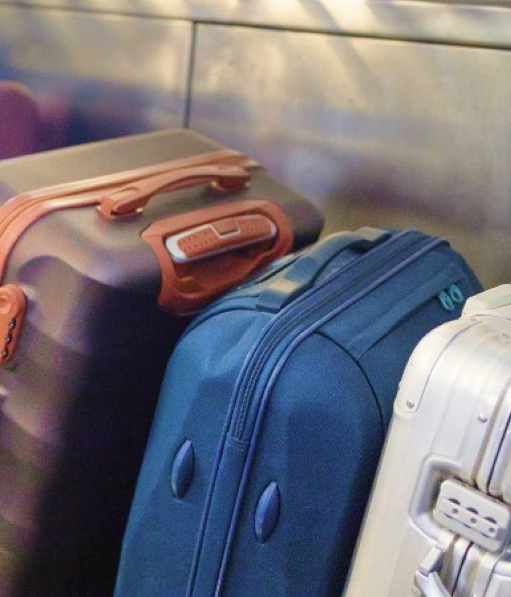
Luggage can make or break a train journey, and Avlo and OUIGO handle it quite differently. Avlo allows passengers to bring a small handbag or backpack up to 36 × 27 × 25 cm, plus a medium cabin suitcase measuring 55 × 35 × 25 cm, and there are no weight limits on either piece.
If you need extra space, you can add a larger suitcase of up to 85 × 60 × 35 cm, for a modest fee. This can be done during booking or just before departure, which is especially useful for families, long trips, or travellers who simply like to pack more.
OUIGO's baggage policy is less flexible. The basic ticket covers one handbag of up to 27 × 36 × 15 cm and one cabin suitcase measuring 55 × 35 × 25 cm, but if you want to carry additional or oversized luggage, you must purchase the extra baggage option in advance or up to 30 minutes before the train departs.
XL luggage can weigh up to 25 kg and measure up to 2 metres total across all sides. Failing to book it ahead results in a €25 fee at the station, which can be an unpleasant surprise.
For passengers travelling light with just one bag and a cabin suitcase, both Avlo and OUIGO are fine. However, for anyone carrying extra items or bulky luggage, Avlo baggage allowance offers a more flexible approach with lower fees for additional baggage. Knowing the baggage rules before you travel helps you avoid hidden fees and ensures a smooth, stress-free journey on Spain's high-speed trains.
Wi-Fi and connectivity: Do both offer free Wi-Fi?
For anyone who relies on the internet during travel, Avlo's free Wi-Fi provides clear convenience, while OUIGO Wi-Fi price means passengers may need to pay to stay online.


Avlo vs. OUIGO onboard catering services
For passengers who value speed and simplicity, Avlo's vending machines and mobile bar work well. For those who enjoy a broader selection and a bit of service interaction, OUIGO's OUIBAR makes the journey feel more comfortable and engaging.
Onboard entertainment
For travellers who prefer free streaming and flexibility, Avlo is convenient. OUIGO can be just as fun, but staying online may require a small extra cost or one of the ticket bundles.

Train Type: What is the difference between Avlo and OUIGO trains?
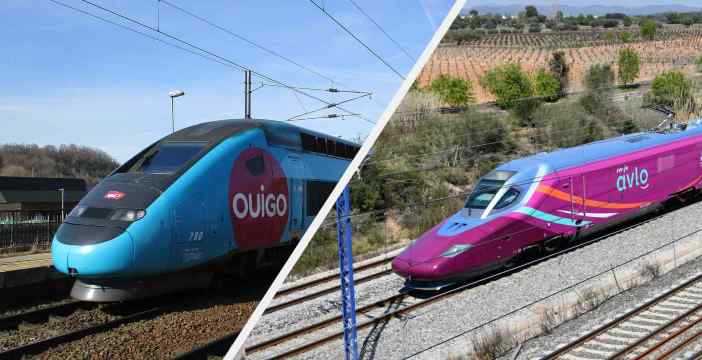
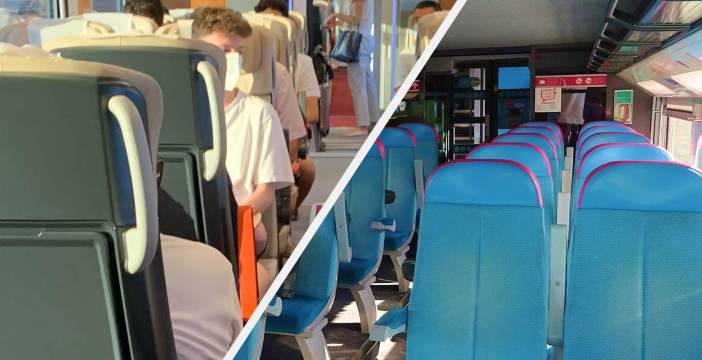
Spain’s high-speed trains aren't all the same, and the choice between Avlo and OUIGO affects your comfort and experience. Avlo uses 106 (Avril) and 112 series single-deck trains, equipped with reclining seats, power outlets at every seat, and air conditioning. Capacity ranges from 438 to 581 passengers depending on the model, providing a smooth, predictable ride across the country's main routes.
OUIGO, in contrast, operates Alstom Euroduplex double-decker trains, reaching up to 1,018 passengers. Travellers can select the "Sky" upper level or "Ground" lower level, and choose between standard or XL seats. XL seats are 33% wider, ideal for long trips, and the upper deck offers a fun perspective, especially appreciated by families with children.
Avlo delivers a consistent, no-fuss journey with reliable comfort, while OUIGO's double-decker design offers more seating options, higher capacity, and a unique onboard experience. Choosing between them depends on whether you prefer simplicity or extra features and space for your high-speed adventure.
Additional benefits and loyalty programmes
Passengers who travel often and want to accumulate rewards or enjoy VIP access, Avlo provides clear advantages. OUIGO focuses on keeping fares low, with benefits available only through optional paid bundles.

Avlo vs. OUIGO comparative table
| Feature | Avlo | OUIGO |
|---|---|---|
Starting price | € 7 | € 9 |
Children | €7 (under 14) | €7 (ages 4–13), free (0–3) |
Included luggage | Hand + cabin (both) | Hand + cabin (both) |
Wi-Fi | Free | €3 extra |
Entertainment | PlayRenfe free (available on some trains) | OUIFUN €3 (paid service) |
Cafeteria | Vending machines | OUIBAR (attended service) |
Train type | Single level | Double-decker (upper and lower) |
XL seats | Not available | Yes (33% larger, extra cost) |
Free commuter trains | | |
Loyalty programme | Más Renfe (earn points, VIP access) | |
VIP lounges | Yes (with Más Renfe membership) | |
Door closing time | 2 minutes before departure | 5 minutes before departure |
Avlo and OUIGO: Which to choose for your train journey?
Picking between Avlo vs. OUIGO hinges on what matters most for your trip. Avlo is ideal if you want wider route options, access to the Renfe ecosystem, and perks like the Más Renfe program and Club Lounge access for elite members. Its single-deck trains offer consistent comfort, flexible baggage rules, and free onboard entertainment, making it a great choice for families or frequent travellers.
On the flip side, OUIGO stands out for passengers seeking the lowest base fare and a more unique travel experience. Its double-decker Euroduplex trains offer upper and lower levels, XL seats, and a lively, novel atmosphere, though extras like Wi-Fi or premium seats are paid separately or via bundles.
Using our TrainPal comparator, you can easily book cheap train tickets in Spain, check route options, and onboard features to find the option that fits your budget and travel style best on Spain’s trains, including AVE.
 New user welcome pack